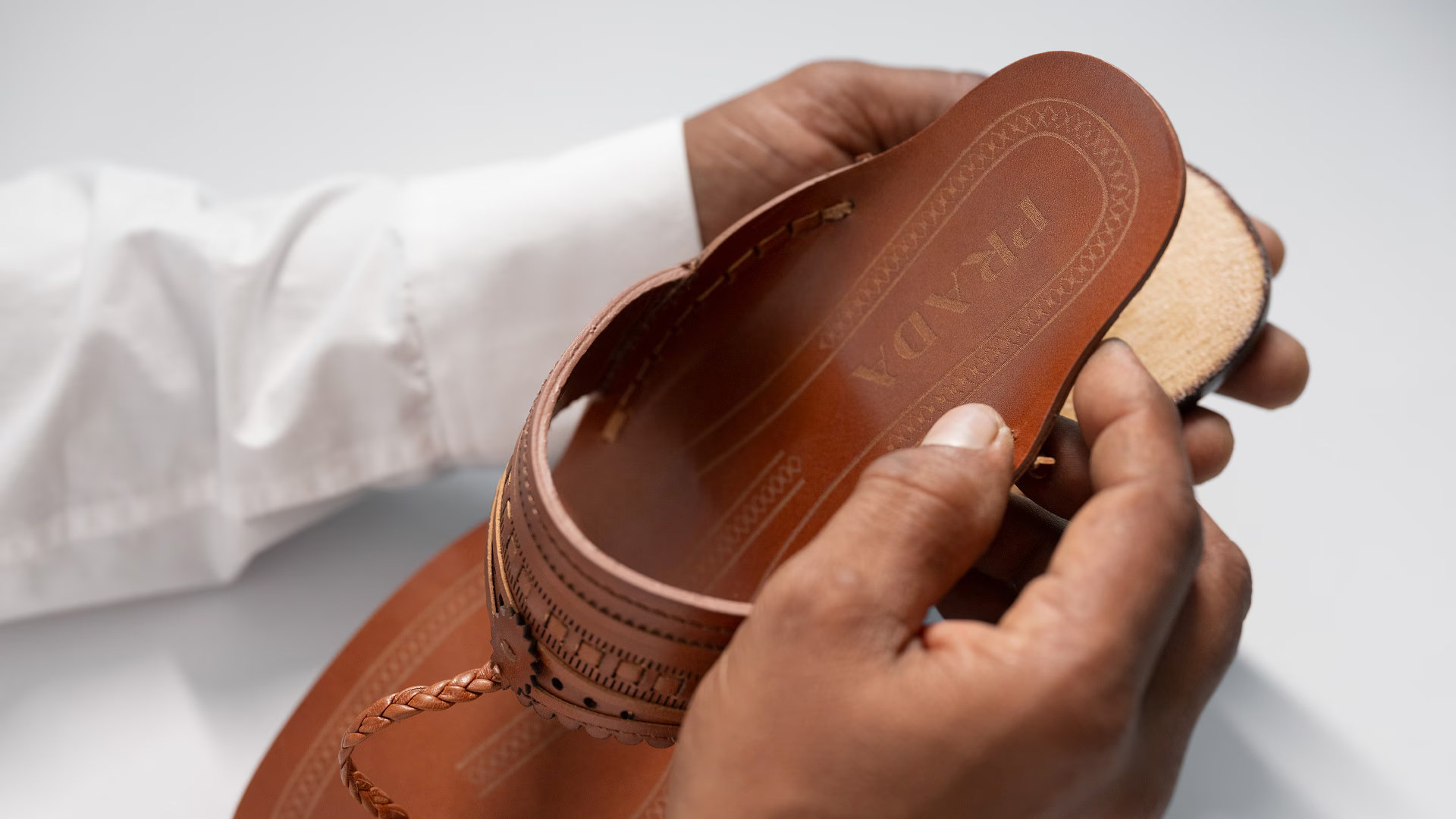
Last year, Prada faced sharp criticism in India. The brand had showcased sandals that closely resembled traditional Kolhapuri chappals but without acknowledging their origin. As a result, the backlash was immediate and loud, with accusations of cultural appropriation. However, less than a year later, the story has taken a different turn. Prada is now returning to the same design, but this time with collaboration, credit, and local involvement at the center.

Breakdown:
Following the controversy in 2025, Prada has launched a limited-edition collection inspired by Kolhapuri chappals, this time produced in partnership with Indian artisan groups. The sandals are being handcrafted in Maharashtra and Karnataka, the regions where this traditional footwear originates. In addition, the brand is working with state-backed organizations such as LIDCOM and LIDKAR to ensure authenticity and local participation.
This shift reflects a more structured approach. Rather than simply drawing inspiration, Prada has integrated local craftsmanship into its production process. Around 2,000 pairs are expected to be produced, with each pair priced in the luxury range and sold globally through select stores and online platforms. As a result, the same design that once sparked criticism is now positioned as a collaborative product.
At the same time, the initiative goes beyond just the product. Prada has also committed to a three-year training program for artisans, designed to enhance technical and design capabilities. This program, developed in partnership with institutions such as the National Institute of Fashion Technology, is expected to reach around 180 artisans. In addition, some participants may get exposure to international training through Prada’s own academy.
However, the pricing still highlights an underlying tension. While traditional Kolhapuri chappals are typically sold at a fraction of the cost in India, these versions are priced significantly higher in global markets. This contrast continues to raise questions around value, branding, and who ultimately captures the economic upside.
Why this matters:
This is not just a fashion story, but a broader lesson in how global brands respond to criticism. When cultural appropriation is called out, the response can either be defensive or adaptive. In this case, Prada has chosen to shift toward collaboration, which helps rebuild credibility while also creating economic opportunities for artisans. At the same time, it sets a precedent for how traditional crafts can be integrated into global supply chains with recognition and participation.
The Big Picture:
More broadly, this reflects a growing shift in consumer expectations. People are no longer just buying products; they are paying attention to the stories behind them. As a result, brands are being pushed to move from inspiration to inclusion. This trend is likely to continue, especially as local craftsmanship gains global attention. Consequently, the future of luxury may depend as much on authenticity and partnerships as it does on design and branding.
The Crunch:
The same product that once triggered backlash is now being sold as a collaboration. That shift shows how quickly narratives can change when credit and participation are brought into the picture. However, it also leaves one question open. Who truly benefits when tradition meets luxury